Analyzing Karl Otto Paetel’s National Bolshevik manifesto
by Zoltanous
Introduction
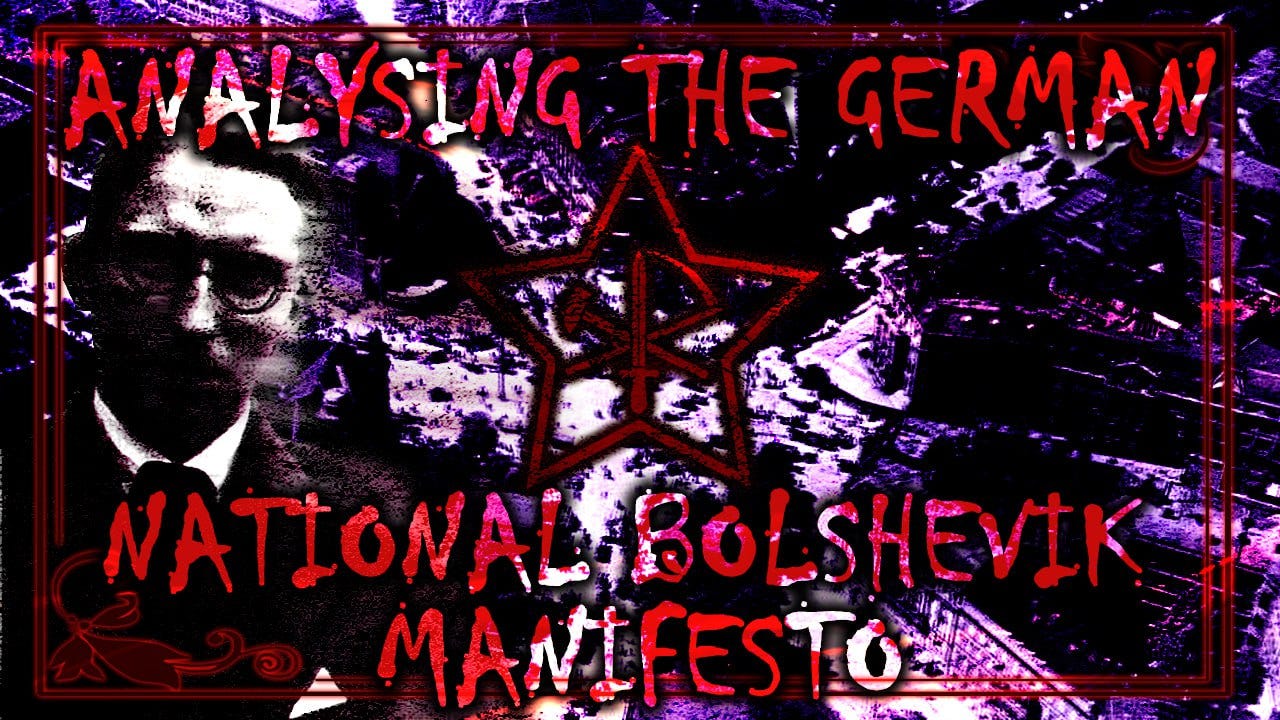
Karl Otto Paetel (1907–1975) was a German journalist, intellectual, and revolutionary nationalist whose The National Bolshevik Manifesto articulated a radical synthesis of socialism and nationalism amid the chaotic disintegration of the Weimar Republic. Born in Berlin to a petit-bourgeois family, Paetel’s early life unfolded against the backdrop of post-World War I upheaval. He pursued formal education at the University of Berlin, where he studied history under luminaries like Friedrich Meinecke, immersing himself in Germany’s tumultuous past, and sociology under emerging scholars of the discipline, sharpening his grasp of social dynamics. His academic path extended briefly to the University of Heidelberg, a hub of nationalist intellectual ferment, where he engaged with philosophical currents — likely encountering the works of Hegel and Spengler — that would later inform his manifesto’s idealist bent. Expelled from Berlin’s Humboldt University student rolls in the mid-1920s for disruptive anti-Versailles protests, Paetel channeled his energies into the radical youth movement, a crucible for his revolutionary nationalism.
A prolific and combative writer, he edited journals such as Die Sozialistische Nation and Das Junge Volk, honing a polemical voice that blended proletarian advocacy with national fervor. In 1930, he founded and led the Group of Social Revolutionary Nationalists (GSRN), a loose coalition of intellectuals and activists pushing for a proletarian-led German renaissance — an ambition crystallized in his manifesto. Paetel’s uncompromising stance against the Nazi regime, which he saw as a betrayal of revolutionary ideals, led to his exile in 1935. Fleeing first to Paris, he mingled with émigré circles critical of Hitler, before settling in New York by the early 1940s. There, he sustained his intellectual output, writing for German-language exile publications and corresponding with figures like a young Henry Kissinger in the 1950s, with whom he debated geopolitics, German identity, and the post-war order. Penned amidst Weimar’s collapse, Paetel’s manifesto rejects both fascism and the borderless universalism of Marxist internationalism, proposing instead a vision of a sovereign, socialist Greater Germany rooted in the Volk’s historical destiny
On The National Bolshevik Manifesto
Nationalism
Paetel’s nationalism breaks from bourgeois reverence for tradition, envisioning a radical rebirth where the proletariat usurps a decaying elite. He sees Germany as a debt-laden colony under the Versailles and Young treaties, stripped of sovereignty and purpose. His mission is to forge a homeland for the Fatherland-less, with Germany as the epicenter of Europe’s destiny. He predicts a monumental clash within the “German Volkskörper” between global capitalism and socialist statehood, resolved not by Western liberalism or Eastern Bolshevism, but by a distinctly German principle — a proto-Duginist stance harmonizing historical roots with revolutionary progress.
“Germany has to fight today for the freedom of its unfree-born children, for a future home for its homeless… In German territory will the vision of our century be shaped.”
— Karl Otto Paetel, The National Bolshevik Manifesto
The Task
Paetel casts National Bolshevism as the architect of a German nation-state surpassing the aborted Ottonian, Hohenstaufen, and Bismarckian attempts. He warns of “Switzerlandization” — a drift into fragmented, multi-ethnic irrelevance — unless socialism and revolution unify the Volk. The proletariat, unshackled from class, chaos, and victimhood, becomes the guarantor of this eternal Germany, a nation defined not by past glories but by a future forged in struggle.
Ten Years of ‘National Bolshevism’
Paetel traces National Bolshevism’s Weimar origins, a term the bourgeois press coined to capture the volatile merger of nationalist youth and proletarian radicals. It crystallized through Brockdorff-Rantzau’s defiance of Versailles, Lenin’s Rhine aid offer, and Hamburg’s Wolffheim-Laufenberg circles, which blended communist fervor with Freikorps defiance. These early waves — later echoed in Munich and Thuringia — laid the groundwork for a movement Paetel would refine in the late 1920s.
Young Nationalism
Rooted in the anti-Versailles youth movement, Paetel’s radicalism reflects his expulsion from school for protesting and his disdain for bourgeois failures: a lost war, a botched revolution, and Weimar’s groveling to Paris and Wall Street. This triple collapse drives youth toward socialism — not as sentimental proletarians, but as guardians of German heritage, forging a revolutionary consciousness from national ruin.
War and Peace
Paetel judges war and peace by their service to national sovereignty, not abstract morality. War earns sanctity only when vital for the Volk’s freedom, a stance rejecting Ernst Jünger’s romantic war-as-adventure ethos. Foreign policy hinges on the question “What for?” — a pragmatic lens dismissing both pacifist illusions and militarist excess, grounded in the nation’s existential needs.
The Nation as the Highest Value
Paetel elevates the nation as an eternal, fateful force, not a Marxist transient to be dissolved. Echoing Spengler’s view of peoples as born, not evolved, he deems it the “magical zero-point” ordering politics, economy, and life. This metaphysical core resists Marxist amalgamation, rooting German identity in a sovereign destiny beyond rational debate.
Marxism and the National Question
Paetel contrasts Lenin’s borderless Soviet vision with his own, arguing socialism amplifies national distinctiveness, not erases it. Citing Hegel and Ranke, he frames the state as a spiritual manifestation of the Volksgeist, not merely an economic scaffold. Where Marxists see nations merging into a higher unity, Paetel sees socialism reinforcing German historical consciousness against Western homogenization.
Prussia as a Principle
Prussia’s ethos of discipline and collective will anchors Paetel’s socialist ideal. He invokes Frederick the Great’s servant-state model — forged in blood and steel — not the Christian nostalgia of Junker lore. This secular Prussianism, shunning romantic feudalism, offers a template for a revolutionary Germany where the Volk serves the state, and the state the Volk.
The Class Struggle as a Nationalist Demand
Class struggle, for Paetel, is an organic Volk renewal, not a Marxist contrivance. The proletariat, as history’s next bearer, seizes economic power to forge a nation, not merely abolish classes. On Jews, he proposes integration or emigration under socialism, granting cultural rights but barring executive roles — a pragmatic stance diverging from Nazi racialism, rooted in eliminating capitalism’s exploitative “Jewish spirit.”
Versailles
Versailles is Germany’s crushing boulder, demanding not revision but annihilation.
“The fatherland is not an outdated idea; an attack on its independence is an assault on civilization”
— Karl Otto Paetel, The National Bolshevik Manifesto
This echos Jaurès, it frames resistance as a proletarian imperative to reclaim sovereignty and socialism from foreign shackles.
Revolutionary Foreign Policy
Paetel envisions a Soviet alliance against Versailles and the West, leading a “League of Oppressed Nations” over colonial exploitation. He scorns the NSDAP’s pro-English, anti-Russian tilt as a capitalist betrayal, misaligned with Germany’s revolutionary destiny. This front, rooted in Brockdorff-Rantzau’s anti-imperialist cry, unites the oppressed globally under German socialist leadership.
The New Faith
Paetel pits a Germanic paganism — centered on blood, soil, and race — against Christianity’s “Oriental” dominance, epitomized by Brüning’s faith in Eternal Rome. This cosmic religiosity, emerging from thinkers like Stefan George, fuels the revolution’s spiritual legitimacy, unshackling Germanic life from Charlemagne’s Christian yoke.
Opposition to Fascism
Paetel rejects fascism as a bourgeois distortion, a critique spanning Strasserists, the NSDAP, and Italian models. He urges these factions to abandon reformist delusions and join the KPD in a revolutionary front, arguing fascism’s anti-Marxism betrays the Volk for propertied elites.
Reformed National Socialism?
Strasserists and Stennes’ splinter groups seek to salvage National Socialism by decrying Hitler’s personal flaws, bourgeois creep, and tactical missteps. Paetel dismisses this as futile, arguing the NSDAP’s rot is structural, not personal. Reformers, clinging to the 25-point façade, miss the need for a KPD-aligned bloc to enact true revolutionary change, not a polished echo of Hitler’s compromise.
The Fascist Mistake
Paetel pinpoints the NSDAP’s fatal error in its 1919 pivot from anti-Versailles rebellion to anti-Marxism, a shift mirroring Italian fascism’s trajectory. Initially, both movements bore socialist hues — Italy’s Fascios paralleled Germany’s USPD — but bourgeois fear of Bolshevism flipped them into capitalist shields. In Italy, fascist railwaymen crushed strikes, and paramilitaries, backed covertly by the state, dismantled syndicalist factory occupations, cementing Mussolini’s “Peace and Order” for the establishment. The NSDAP followed suit, forsaking the Fatherland-less for a propertied alliance, proving fascism’s revolutionary rhetoric a hollow mask for bourgeois security. This misstep, Paetel argues, dooms any fascist renaissance built on the same anti-Marxist foundation.
The Historical Error of the NSDAP
The NSDAP’s alliance with capital against labor marks its historical blunder, transforming a potential anti-Versailles force into reaction’s pawn. Paetel details how Munich’s early council, fueled by anti-capitalist zeal — “breaking the bondage of interest” — appealed to radicalized soldiers and students, only to be co-opted by a bourgeoisie tolerating youthful excess to crush Marxist gains. Finance capital, landowners, and feudal nostalgists backed the NSDAP to restore pre-Weimar power, ignoring its programmatic blemishes. This wasn’t Stennes’ or Strasser’s failure, but an inevitable dynamic of siding with capital. Paetel insists Marxism’s flaws — outdated worldview or not — must be transcended internally, as Russia shows, not bludgeoned by stormtroopers.
Council State or Corporate State?
Paetel champions a council state — rooted in Germanic self-rule — over fascist corporatism.
“The council-idea strives to bring spirit and active living back to our völkisch existence.”
— Martin Spahn quoted in The National Bolshevik Manifesto by Karl Otto Paetel
Paetel envisions a bottom-up structure where workers and peasants govern via staggered elections, shattering party bureaucracy. Contrastingly, Othmar Spann’s corporate state, steeped in Catholic universalism, entrenches economic interest groups, reducing the state to a production firm. Paetel’s councils integrate leadership by merit, not caste, proving racial worth — like Nordic claims — through revolutionary service, not dogma.
Socialism
Paetel’s socialism demands total nationalization — land, industry, trade — enforced by a people’s militia, not mercenaries.
“The fundamental law of true nationalist socialism remains: the economy in the hands of the nation.”
— Karl Otto Paetel, The National Bolshevik Manifesto
Paetel rejects Strasser’s profit-sharing or Sombart’s half-measures as semi-fascist diversions, insisting on an economy wholly serving the Volk.
Nationalist Communism
National Communism merges socialist resolve with nationalist faith, partnering with the KPD to smash Versailles and fascism. It seeks a sovereign Greater Germany, not a reformed NSDAP, forming cadres ready to sever bourgeois ties for the nation’s sake.
The Face of National Communism
This vision demands a socialist revolution, planned economy, and council-state, nationalizing production and land, allied with Russia against Western ethnic decay. It includes expropriating estates, replacing Roman law with German common law, and pursuing Russo-German autarchy — radical steps for a sovereign Volk.
Why not KPD?
Despite anti-fascist synergy, Paetel’s sovereign nation diverges from the KPD’s classless fusion. “We fight for a sovereign nation, not a classless amalgamation,” he asserts, favoring autarchy over global planning, rooted in differing views of class struggle and peace.
Happiness or Freedom?
Paetel prioritizes collective freedom over personal bliss.
“The love of Fatherland is a great and terrible thing. It is without mercy… for the public good”
— Saint-Just quoted in The National Bolshevik Manifesto by Karl Otto Paetel
He demands sacrifice for national power, not humanitarian comfort, promising future prosperity through struggle.
Position on The Peasantry
Peasants, a secondary revolutionary force, lack the proletariat’s mission. Paetel proposes state-backed cooperatives within a planned economy, preserving their autonomy against Marxist collectivization.
Rural Revolution?
Urban revolution leads, with peasants as allies. Paetel warns of fascist rural encirclement starving cities, urging economic incentives to align them with the proletarian vanguard.
The Peasant Question in Germany
German peasants prioritize autonomy, not proletarian self-abolition. Paetel’s cooperative model suits Germany’s intensive farming, unlike Russia’s land-gift collectivism, integrating peasants into socialism without erasing their identity.
Nationalism (Revisited)
Paetel closes reaffirming the nation as a historical force, born from struggle, not a transient ideal, grounding his revolution in this enduring reality.
Conclusions
The National Bolshevik Manifesto melds socialism and nationalism into a potent critique of globalism and a claimed critique of fascism, enriched by his council-state, Prussian ethos, and peasant cooperatives — elements that, as an idealist fascist, I find invigorating for their revolutionary zeal. His vision of Germany as “the vision of our century,” forged in struggle, resonates deeply with my own idealist commitment to a transcendent national destiny. Yet, I diverge on his exaltation of the nation as an eternal value: while it aligns with my ideals, it underplays the primacy of will, dynamism, myth and leadership — core to my fascist stance— that drive history beyond a mere national essence.
Paetel’s critique of fascism, as laid out in “The Fascist Mistake” and “Opposition to Fascism,” does not withstand scrutiny. He frames it as a bourgeois betrayal of the Volk, a charge that crumbles under the analyses of Roger Griffin, Stanley G. Payne, and A. James Gregor. Griffin’s palingenetic ultranationalism, Payne’s structural typology, and Gregor’s revolutionary framing reveal fascism’s ideological vitality, not a mere elite prop. Paetel’s oversight is stark when considering Alfred Rosenberg’s neo-paganism, which infused Nazism with an occult spiritualism akin to Paetel’s own national fervor — hardly the propertied capitulation he decries. This strand, echoed in Himmler’s rites, underscores Nazism’s radical potential, exposing Paetel’s critique as overreach. His true brilliance lies in dismantling borderless communist illusions. Grounded in sovereignty and Carl Schmitt’s friend/enemy distinction, he envisions a multipolar socialist world — proven by the Sino-Soviet split — where competition and conflict safeguard the Volk’s purpose. His council system, mirroring Sorel’s federations and aiming to “bring spirit and active living back to our völkisch existence,” empowers workers with direct, unbureaucratic force — a point where his idealism and mine converge.
Imperfect but incisive, Paetel reframes National Bolshevism beyond caricature, offering insights that demand engagement. Read the manifesto and judge it for yourself.

