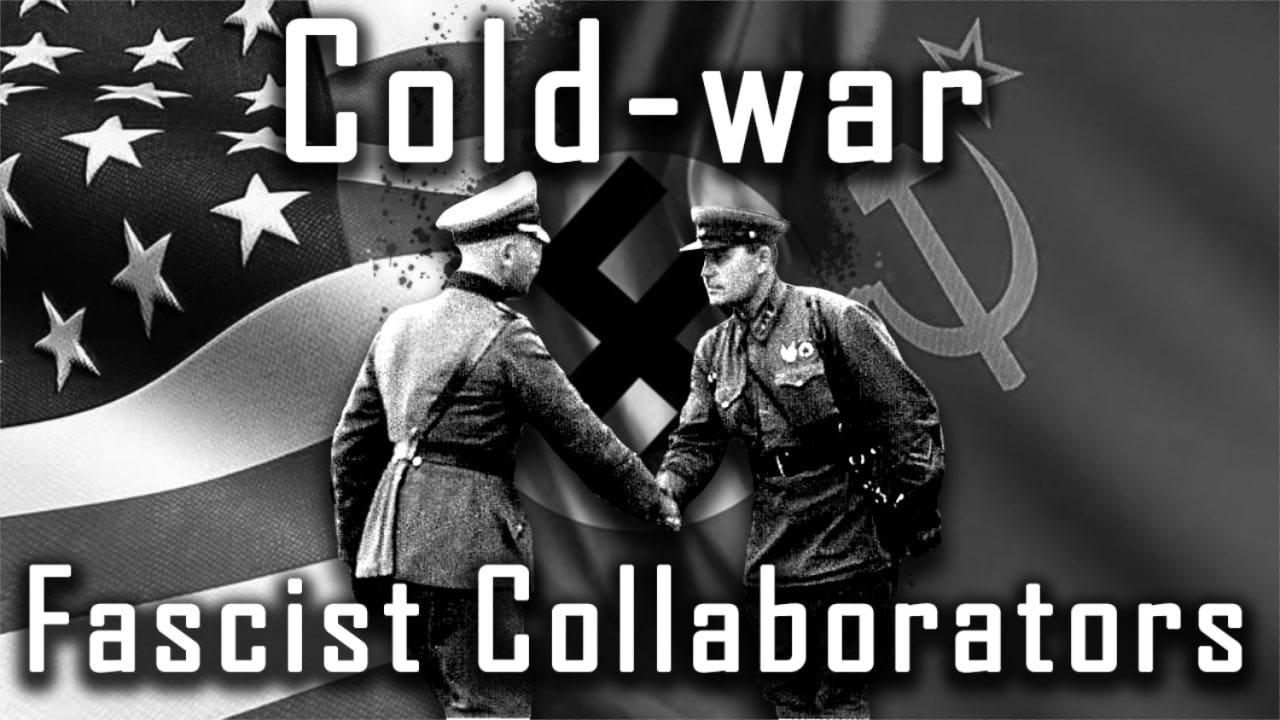
Cold-war Fascist Collaborators
Cold-war Fascist Collaborators
by Archer Andrewes
Claiming that the US government sympathizes with German Nazism or Italian Fascism is a popular but inaccurate assertion among American communists. The reality is that US leadership and the broader Western establishment are primarily inspired by liberalism. Nonetheless, this does not whitewash liberalism's own troubling history, which includes involvement in warfare, colonization, genocide, and various forms of oppression. There's no need to draw parallels with 20th-century fascism to find fault with the modern West; a straightforward look at history exposes the dark legacy of liberalism, including its role in North American genocide, the Atlantic slave trade, the eugenics movement, multiple global conflicts, and the deployment of nuclear weapons. Fascism, by contrast, was a relatively short-lived ideology that was overthrown at the end of World War II after about two decades in power. Despite its own violent and racist tactics, such as Italian aggression in Ethiopia and Hitler's expansionist policies, fascism had a complex character. It was marked by a form of nationalism that opposed financial capitalism and advocated for national welfare and protectionist measures, alongside policies of nationalization and expropriation, while some expressed support for anti-imperialist movements worldwide. The involvement of figures like Indian anti-imperialist Subhas Chandra Bose and Italy's communist pioneer Niccola Bombacci demonstrates this, an often ignored or deliberately neglected aspect within the broader historical narrative.
With the Cold War's advent, both the US and the USSR recruited former fascists, signifying the persistence of the ideological spectrum that fascism encompassed. Notably, Operation Gladio, a secret NATO and CIA-supported network, was originally established to counter a potential Soviet threat but was later implicated in domestic political manipulation and violence in Western Europe, particularly during Italy's Years of Lead. The network's existence was unveiled following the Peteano bombing in 1972, which, although first blamed on leftist extremists, was actually perpetrated by right-wing terrorist Vincenzo Vinciguerra and investigated by Judge Felice Casson. In 1945, Walter Kopp, a former Wehrmacht officer, reached out to American official John Jay McCloy about fears of a Soviet incursion. Kopp was then appointed to lead a subnetwork in Germany, later characterized in CIA documents as having "Nazi tendencies." The formation of the modern German Bundeswehr was significantly influenced by former Nazi officers Adolf Heusinger and Hans Speidel, who played key roles during World War II, with Heusinger involved in planning the attack on the Soviet Union and Speidel participating in the failed assassination attempt on Hitler. Operation Paperclip was a program whereby the US granted asylum to around 1,600 former Nazi scientists, such as Herbert A. Wagner and Wernher von Braun, to leverage their technical knowledge.
The Soviet Union conducted a parallel initiative, Operation Osoaviakhim, which was even more extensive, relocating over 2,200 German specialists and their equipment to the USSR on October 22, 1946, to aid their scientific endeavors, with notable figures like Peter Adolf Thiessen and Manfred von Ardenne. Otto Grotewohl, East Germany's former Premier, disclosed an attempt by Soviet intelligence to recruit Hitler's deputy, Rudolf Hess, from Spandau prison to lead a political party in support of communism, an offer Hess declined. Nonetheless, East Germany actively enlisted former NSDAP members into its ranks. Wilhelm Adam, ex-SA and a captive from Stalingrad, later aligned with the Soviet-supported National Committee for a Free Germany and co-founded the National Democratic party of Germany, aiming to integrate former Nazis under a banner of socialism and patriotism. Conversely, in West Germany, Major General Otto Ernst Remer, who played a key role in thwarting the 20th of July Plot against Hitler, established the Socialist Reich party (SRP) in 1949. The SRP received clandestine support from the Soviet Union and East Germany and amassed more than 10,000 members before its dissolution in 1952. Remer subsequently engaged with Soviet interests abroad, including arms dealings with various communist groups. Furthermore, the Stasi, East Germany's secret police, recruited ex-SS intelligence officers like Joseph Settik and Hans Sommer for espionage activities in West Germany and globally, reflecting the complex intertwining of former Nazi elements with Cold War espionage.
Conclusions
It is true that during the Cold War, both the United States and the Soviet Union supported various movements and regimes that aligned with their geopolitical interests, regardless of their ideological nature. This often resulted in support for groups or individuals who were seen as opposing the other side, even if they espoused extreme ideologies or engaged in oppressive actions. It is crucial to acknowledge the intricacies and complexities of international relations during the Cold War. To simplify this era into a narrative of ideological affinity between the United States or the Soviet Union and fascist movements would be an oversimplification.
During this period, both the United States and the Soviet Union pursued strategic interests, often aligning themselves with groups or regimes that stood in opposition to their adversaries. This included America's support for various factions such as Islamic extremists like ISIS and the Taliban, communists like Pol Pot and the Shining Path, Anarchists like Rojava, as well as authoritarian liberals like Pinochet. Similarly, Putin's Russia has continued this trend by supporting European neo-fascist movements, South American socialists, secular Arab regimes, and various African governments. This strategic calculus can be encapsulated by the principle "the enemy of my enemy is my friend," which highlights the pragmatic approach taken in geopolitical struggles. Yet, it's crucial to understand that this support doesn't automatically mean there's an ideological agreement or endorsement. Rather, it highlights the intricate nature of international politics, where strategic interests frequently take precedence over ideological coherence.