Communist vs Fascist Socialism
by Judas and Zoltanous
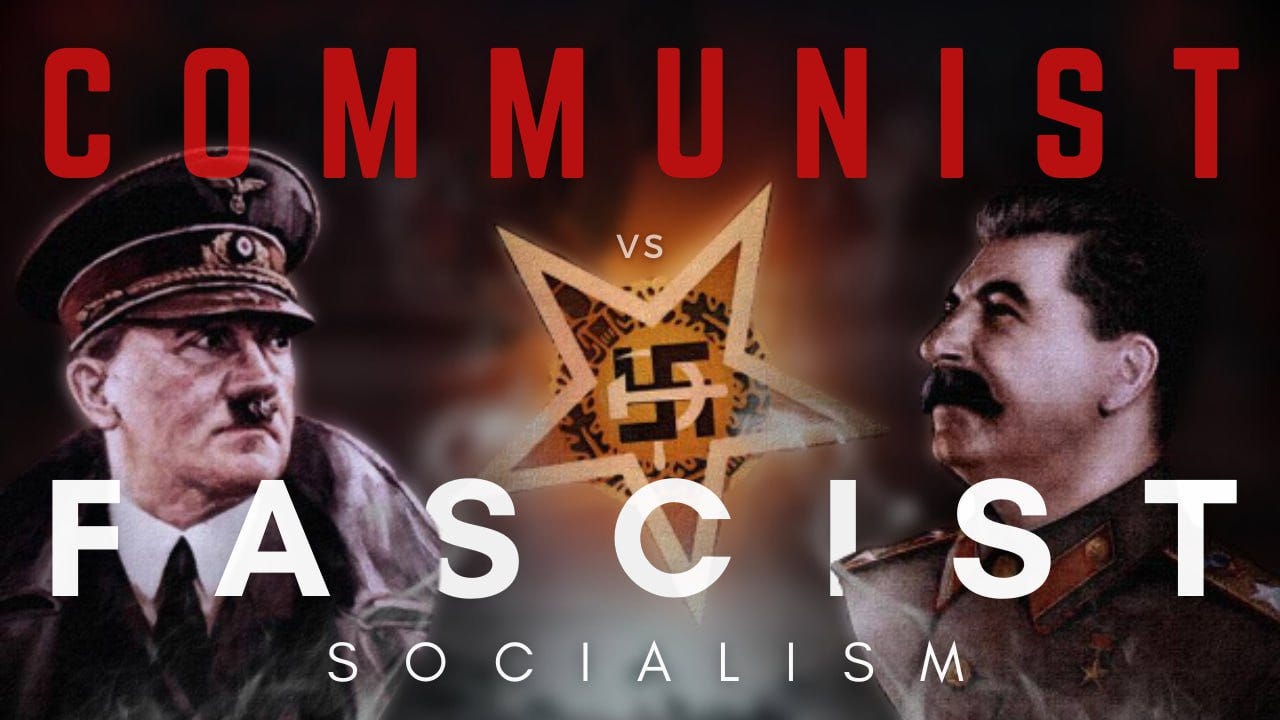
What Are The Differences?
The Communist perspective was driven by the aspiration to "liberate the individual from all bonds that tie him," aligning with the ideals of Humanism. According to the Communists, the Bourgeoisie had betrayed this project and brought about a "false enlightenment." They believed that the Communist individual would serve as the "true Humanist," completing the project and fulfilling the promises that liberals had made but ultimately betrayed.
The Nazis, on the other hand, completely rejected this paradigm. They saw it as delusional and misguided to make such promises. In their view, the individual could only find fulfillment by belonging to a greater whole. As man was inherently social, not liberal, the Humanist project was considered an attack on the very essence and nature of humanity. Unlike the Communists, who sought to fulfill the promises of liberalism, the Nazis aimed to destroy and replace them with something entirely anti-liberal.
To the Nazis, the proclamations of liberalism contradicted the social nature of man. Unlike the Communists, they sought to eradicate liberal ideals entirely and replace them with the recognition that the individual is an abstraction of the mind, subordinate to a greater spirit. There was no concept of the "individual," only the "personality." There was no emphasis on the "collective," but rather on the "community," which was interdependent and harmonized as one.
While the Communists aimed to liberate the individual from all constraints, the Nazis sought to emancipate and elevate the personality into the folk-community (Volksgemeinschaft), where it could be harmonized into something greater than itself. This is why the Nazis emphasized idealism and employed strong anti-materialist rhetoric. They accused the Communists of being akin to the Capitalists, both being driven by materialism and humanism, merely differing in their approaches to fulfilling the Bourgeois project.
Furthermore, in Italy, Fascist philosopher Giovanni Gentile did not reject Marx but rather built upon his ideas, asserting that Marx was actually a "confused idealist" and that Fascism was, in reality, a "better Marxism." Fascism was not "Anti-Marxism" but rather "Post-Marxism" in practice, as it was built upon a coherent ontology unlike the vulgar materialism of Marxists who followed figures like Engels and Lenin.
Gentile's direction of Fascism revolved around the concepts of Fascist socialism, creating an intellectual environment in which some Marxists and independent socialists found a place. Even those intellectuals who had long identified with socialism in some form could identify moral and intellectual affinities within Fascism.
Gentile had recognized socialist values as inherent elements of Fascism since its inception, finding inspiration in the early writings of Marx when Marx was largely influenced by Hegel. Towards the end of his life, Gentile acknowledged the socialist origins of Fascism, identifying Italian communists as "impatient corporatists" who failed to grasp the logical and "dialectical" development of a historic social and philosophical idea.
This modification of Marxism was further complemented by the Fascists' adoption of the ideas of elite theorists Vilfredo Pareto and Gaetano Mosca. These theorists argued that all societies, even those that appeared democratic, were governed by small political elites who ruled over the "masses." According to Pareto, there existed a small political elite that ruled society due to their superior personal qualities and organizational skills, while the mass of society was composed of unintelligent, irrational, apathetic, and poorly organized individuals who could be easily manipulated by political propaganda. This perspective aligns with Sorel's emphasis on political myths and Le Bon's ideas on the irrationality of crowds, influencing mass behavior.
In this manner, Fascism rejected the optimistic Marxist view of the revolutionary potential of the proletariat. It became evident that the working class itself was incapable of organizing a socialist revolution, and any alleged "socialist" revolution would only result in the rise to power of a new elite (Vanguardism) that would rule in its own interests rather than those of the working class it falsely claimed to represent. Fascism believed that real socialism was impossible without an elite to govern it. Hence, the Fascists argued that Marxists had exaggerated the rationality of human behavior, particularly that of the masses.
The Failure of Communist Interpretations of Fascism
First and foremost, it is important to recognize that proponents of the "Capitalism in Decay" argument often rely on selective and out-of-context data, such as Mussolini's actions in the 1920s or quotes that can be misleading. To truly understand and classify Fascist Italy, we cannot simply attribute it to a single set of socioeconomic policies; we must consider different spiritual and economic periods.
When engaging in discussions with individuals advocating for the "Capitalism in Decay" argument, it is crucial to keep in mind their reliance on 1920s data. This period is often seen as the era of "Heroic Capitalism," characterized by industrialization and the consolidation of power. Mussolini, during this time, was attracting support from various factions across Italy and establishing his own base of loyalty.
However, many historians of Fascism argue that the Italian leadership can be best described as a "Developmental Dictatorship," gradually moving towards its own set of goals. The early stages of Fascism in Italy are comparable to the New Economic Policy implemented in the Soviet Union. Taking Lenin out of context would lead to labeling him as a capitalist, highlighting the disingenuous nature of such framing.
When examining Mussolini's policies in the 1920s, it is essential to understand that he adopted certain liberal policies and rhetoric to consolidate power. This has been well-documented by scholars like A. James Gregor. However, it is important to note that as time passed, discontent grew within Fascism, leading to an eventual opposition to liberalism. Mussolini's Italy underwent a period of industrialization, which it later moved away from once the regime believed its goals had been achieved. In fact, Mussolini himself stated in 1933, "Corporatism is a starting point, not an end." Thus, the privatization efforts undertaken by the regime aimed to drive the industrialization of a quasi-feudal Italy, serving as a stepping stone towards socialism.
The truth is that Italian Fascism, like other forms of the ideology, did not align closely with industrialists. Even when acknowledging flaws in corporatism, it should not come as a surprise that Mussolini himself recognized them.
The connections between Mussolini and big industry can also be attributed to the influence of the King and the remaining reactionary forces from the previous regime. As historians have highlighted, these forces were allowed to remain in their positions with the intention of gradually removing them in a bloodless revolution. A similar observation can be made when examining Nazi Germany, if one honestly delves into its history.
One of the main issues with Communists, in general, is their willingness to engage in intellectual dishonesty, particularly when it comes to analyzing regimes other than their own. They often misunderstand Fascist Italy and Nazi Germany, viewing them as a single, abstract entity without taking into account their unique characteristics and complexities.


An example of communist copes
History demonstrates that the policies implemented by the Fascist and Nazi governments provide clear evidence that the events that took place between 1942 and 1945 were a direct consequence of their objectives. The actions and decisions made during this period align with the ideological goals and principles of both regimes.
When someone claims that you haven't read enough books, it is important to challenge them and ask for specific sources that they believe support their arguments. It is worth noting that many highly respected historians of Fascism have discredited these questionable sources. A recommended author to explore regarding this topic is A. James Gregor, who directly addresses and responds to such sources. This highlights the tendency of Communists to disregard the pursuit of understanding reality and to analyze Fascism objectively.


I agree, Hitler does seem to understand human nature far better than Marx.