
The Know-Nothing Party
by Zoltanous
Introduction
Between 1840 and 1860, more than 4.5 million immigrants arrived in the United States, the majority from Ireland and the German states. This migration was driven primarily by the Irish Potato Famine from 1845 to 1852 and by political upheaval following the failed European revolutions of 1848. The influx reshaped the nation’s demographic, economic, and political landscape, particularly in urban centers where competition for jobs and housing intensified. Many native born Protestants viewed the rapid growth of Catholic communities as a threat to social order, political stability, and republican values. By the mid 1840s, the term “nativism” came to describe movements that sought to privilege descendants of the original European settlers of the Thirteen Colonies, who referred to themselves as “Native Americans,” a label distinct from Indigenous peoples.
Fears that Irish Catholics owed political loyalty to the Pope rather than to the United States fueled conspiracy theories and anti-Catholic activism. These anxieties contributed to the formation of secretive political organizations, most notably the Know Nothing movement. Known formally as the American party, its members were instructed to reply “I know nothing” when questioned about the organization. The movement promoted Protestantism, Anglo Saxon identity, and political restrictions on immigrants and Catholics. Its influence spread rapidly in cities such as New York and Boston and reached southern states including Alabama, shaping long standing debates over immigration and American identity.
The Know Nothing Movement
From 1820 to 1845, annual immigration to the United States generally ranged between 10,000 and 100,000 people. Between 1845 and 1854, however, approximately 2.9 million immigrants arrived, many fleeing famine, economic instability, and political repression in Europe. By 1850, foreign born residents made up roughly 10% of the total U.S. population, with particularly high concentrations in northern cities. Immigrants constituted about 51% of New York City’s population, 46% of Boston’s, and 30% of Cincinnati’s. Irish immigrants, many of whom arrived impoverished, were disproportionately represented among recipients of urban charity, accounting for roughly 70% of New York City’s relief cases.
This demographic transformation intensified labor competition, strained municipal resources, and heightened Protestant fears of cultural and religious change. Although immigration levels were lower in southern states such as Alabama, nativist ideas still gained traction among Whigs and Democrats concerned about foreign influence and political instability. Rising tensions were reinforced by sensationalist and often false anti-Catholic propaganda. In Boston and other cities, Catholics were portrayed as morally corrupt and politically dangerous. One of the most influential sources of such fear was Awful Disclosures of the Hotel Dieu Nunnery of Montreal, published in 1836 by Maria Monk. Although later exposed as fraudulent, the book alleged sexual abuse and infanticide within Catholic convents and sold widely, helping to legitimize paranoia and violence.
As Know Nothing organizations spread from northeastern cities to Philadelphia, Baltimore, Louisville, Cincinnati, New Orleans, St. Louis, San Francisco, and smaller cities such as Mobile, Alabama, episodes of political violence increased. Notable incidents included the 1844 Philadelphia Nativist Riots, which left at least 20 people dead; the 1854 St. Louis riots, with an estimated ten to 15 dead; the 1855 Louisville “Bloody Monday” riot, in which at least 22 people were killed; election riots in Cincinnati in 1855 and Baltimore in 1856; and the burning of a Catholic church in Bath, Maine, in 1854. Historians estimate that nativist riots during this period resulted in roughly 60 to 70 deaths nationwide. In Alabama, tensions were most visible during elections, where Know Nothing lodges formed in cities such as Mobile and Montgomery, though violence was generally less severe than in northern urban centers.
Historian David Grimsted situates such violence within the broader political culture of the era, writing that:
“Riots were neither rare nor commonplace in antebellum society but a piece of the ongoing process of democratic accommodation, compromise, and uncompromisable tension between groups with different interests."
— David Grimsted, American Mobbing, 1828–1861: Toward Civil War
As established parties such as the Whigs declined, the Know Nothing movement gained political momentum in the early 1850s. Rooted in secret societies like the Order of The Star Spangled Banner, founded in 1849 by Charles B. Allen, the movement emphasized secrecy, discipline, and ideological conformity. By 1854, its membership reached approximately one million men, representing about 10% of adult males in the North. Although women were excluded from formal membership, they often supported the movement through social networks, community organizing, and the circulation of nativist ideas.
Historian Allan R. Whitmore describes the oath bound secrecy of the movement in Maine, noting that members pledged:
"He would swear not to reveal, nor to permit anyone else to reveal, any signs, secrets, mysteries or purposes of the order unless certain he was..."
— Allan R. Whitmore, A Guard of Faithful Sentinels: The Know-Nothing Appeal In Maine, 1854-1855
The movement evolved from the American Republican party in New York in the early 1840s to the Native American Party later in the decade, and finally to the American party by 1855. Historian Christopher Phillips identifies its defining characteristics as militant nationalism, deep anti-Catholic sentiment, and appeals to working class voters shaped by elite political rhetoric. Similarly, historian Elliott J. Gorn argues that ethnic and religious appeals allowed politicians to mobilize voters across class divisions. In the South, including Alabama, the Know Nothing movement briefly attracted support from both Whigs and Democrats before fracturing over the issue of slavery, mirroring its rapid rise and decline at the national level.
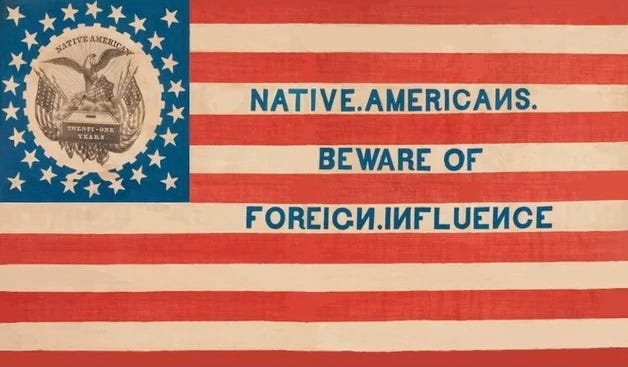
The flag of the Know-Nothings
The Know Nothings promoted an American identity rooted in Protestantism, Anglo Saxon heritage, and republican governance, viewing Catholic immigrants, particularly the Irish and Germans, as threats to this vision. Their 1856 party platform called for extended naturalization requirements, restrictions on foreign born citizens holding public office, and public schooling conducted in English and shaped by Protestant moral instruction, including Bible readings. While the movement generally tolerated Protestant immigrants from northwestern Europe, such as the English and Scots, it strongly opposed Catholic immigration, especially from Ireland and Germany, and expressed suspicion toward southern European Catholics, foreshadowing later anti-Italian sentiment.
“Observing the authoritarian organization of the Catholic Church and its customary association with feudal or monarchical governments, they were tempted to conclude that Catholicism was incompatible with American liberty.“
— John Higham, Strangers In The Land: Patterns of American Nativism, 1860–1925
The party also supported temperance measures that disproportionately targeted immigrant drinking cultures, a stance that may have weakened its appeal among white male voters, the only group enfranchised at the time.
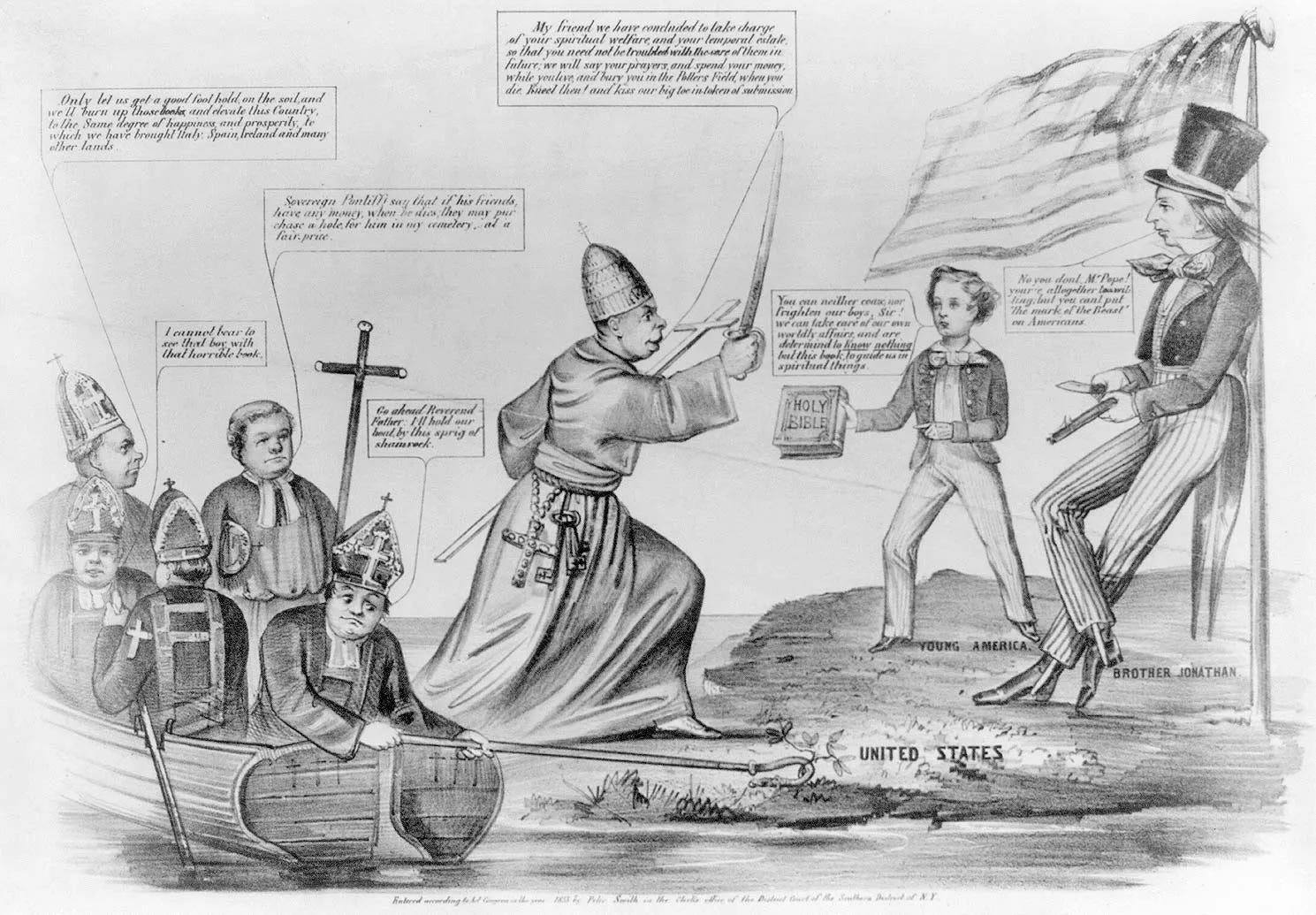
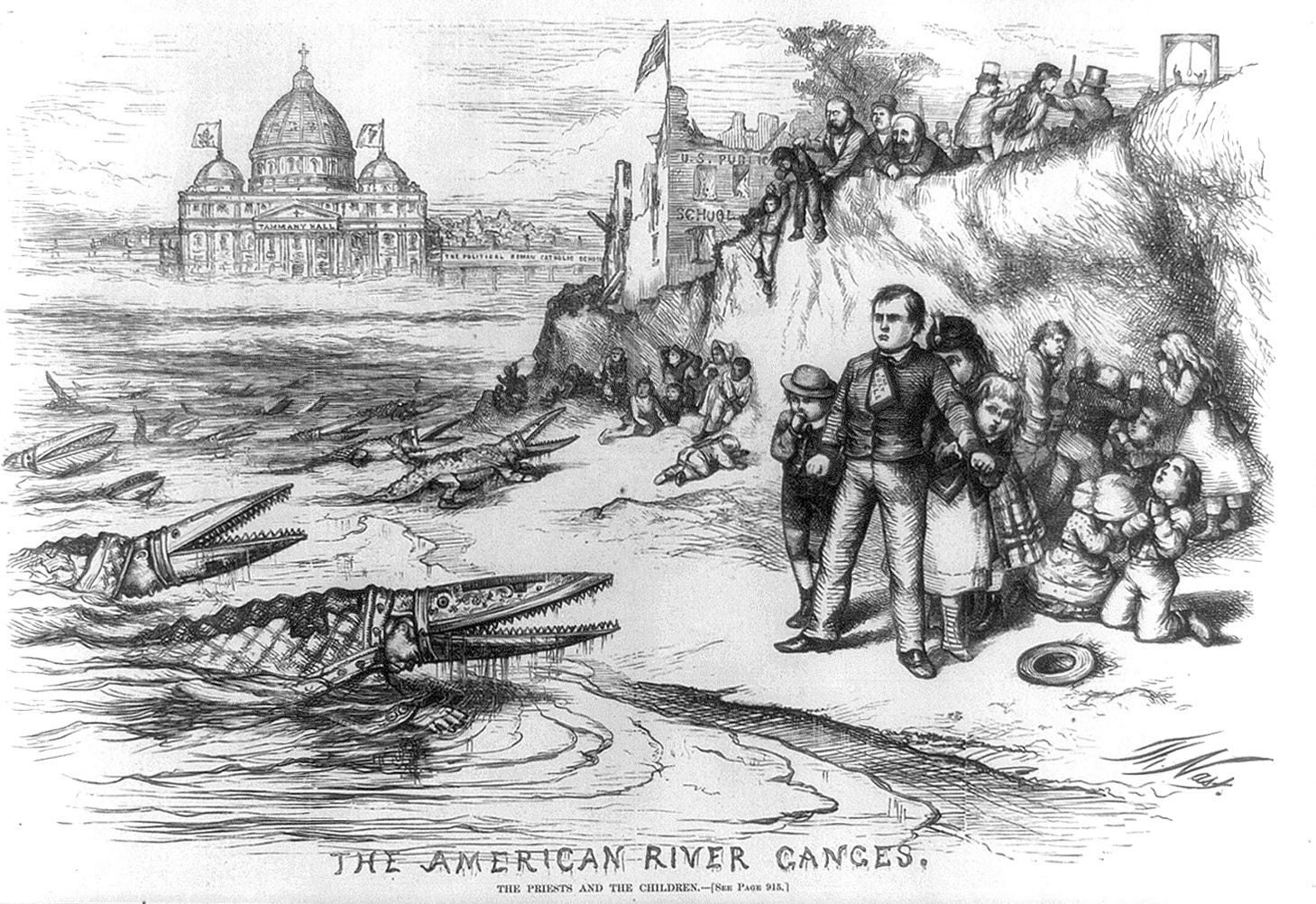
Know-Nothing anti-Catholic propaganda
Two New Yorkers came to symbolize different strands of the Know Nothing movement. Thomas R. Whitney, the son of a silversmith and a professional engraver, authored A Defense of The American Policy, one of the movement’s most influential ideological tracts. Well versed in classical philosophy, Whitney argued that political rights should be reserved for those he believed capable of rational self government. He opposed both women’s suffrage and Catholic immigration, which he viewed as threats to the Founders’ vision of republican liberty, asking rhetorically, “What is equality but stagnation?” Whitney was also active in the Order of United Americans, for which he produced pamphlets and propaganda.
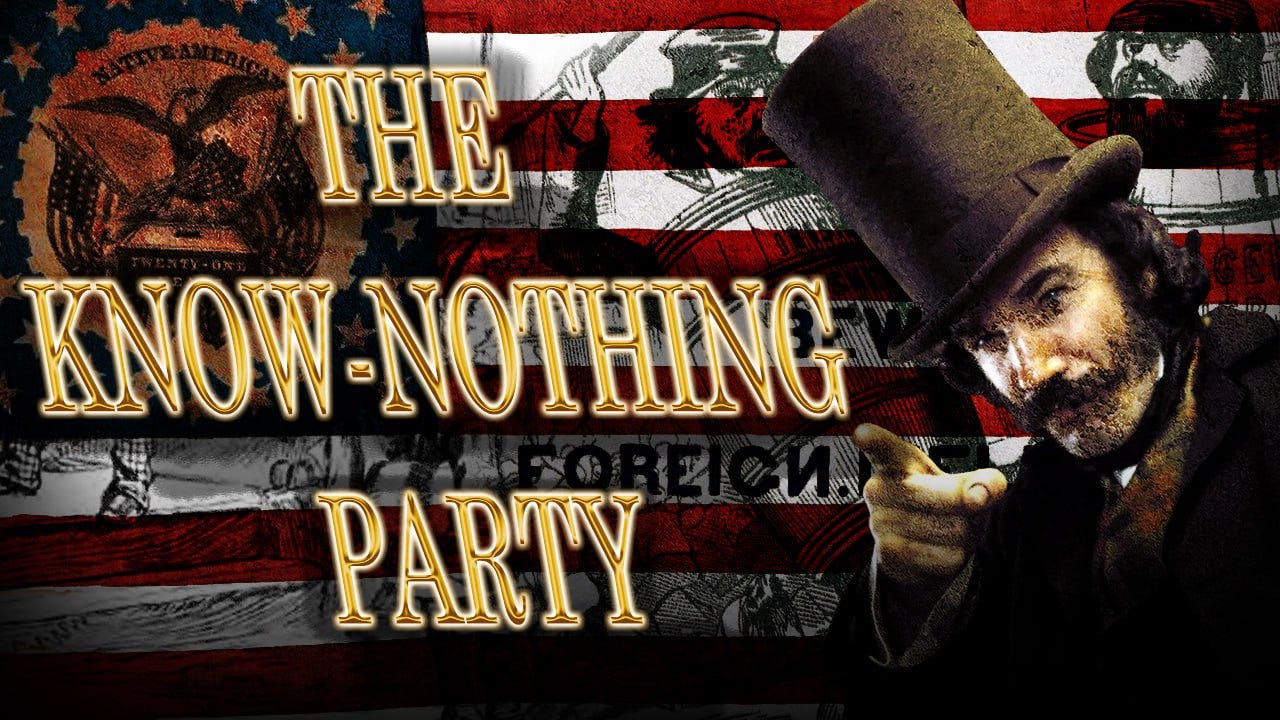
A far more violent expression of nativism was embodied by William Poole, better known as “Bill the Butcher.” A butcher, prizefighter, and leader of the Bowery Boys gang, Poole advanced nativist goals through street violence and intimidation rather than political theory. He was fatally shot in 1855 following a dispute with Irish rivals. Contemporary accounts report that his final words emphasized loyalty to his cause, often rendered as “Goodbye boys, I die a true American,” though the exact phrasing varies by source. His funeral drew an enormous crowd, estimated in the tens of thousands, and elevated him to martyr status among nativists. Poole’s legacy later entered popular culture through Gangs of New York, directed by Martin Scorsese.
A Gangs of New York clip
Lewis Charles Levin was another prominent figure in the nativist movement. Born in 1808 in Philadelphia to a Jewish family, he later converted to Protestant Christianity and pursued a career as a lawyer and political orator. Levin emerged as a leading voice of nativism during the 1840s. In his 1844 pamphlet A Lecture on Irish Catholicism, he warned of what he portrayed as a Catholic political conspiracy undermining American institutions. Through his newspaper, The Daily Sun, Levin regularly disseminated anti Catholic rhetoric and mobilized popular support for nativist causes. Elected to Congress in 1844 as a representative of the Native American party, Levin articulated a vision of American identity rooted in Protestantism and Anglo Saxon heritage, framing Catholic immigration as incompatible with republican self government.
“Native Americanism... is a principle that can never die. It is part and parcel of the country itself, and as natural to our soil as the mountains that rise in the clouds, or the rivers that water our plains.”
— Lewis Charles Levin, quoted in Nativism and the American Political Tradition by Lucas Hartzig
Another prominent figure, Nathaniel P. Banks, a Massachusetts politician, aligned himself with the Know Nothing movement in the mid 1850s and used its organizational strength to win the governorship in 1855. Banks’s subsequent shift to the Republican party by 1857 reflected the rapid fragmentation of the Know Nothings as internal divisions over slavery and sectional politics overwhelmed nativist unity.
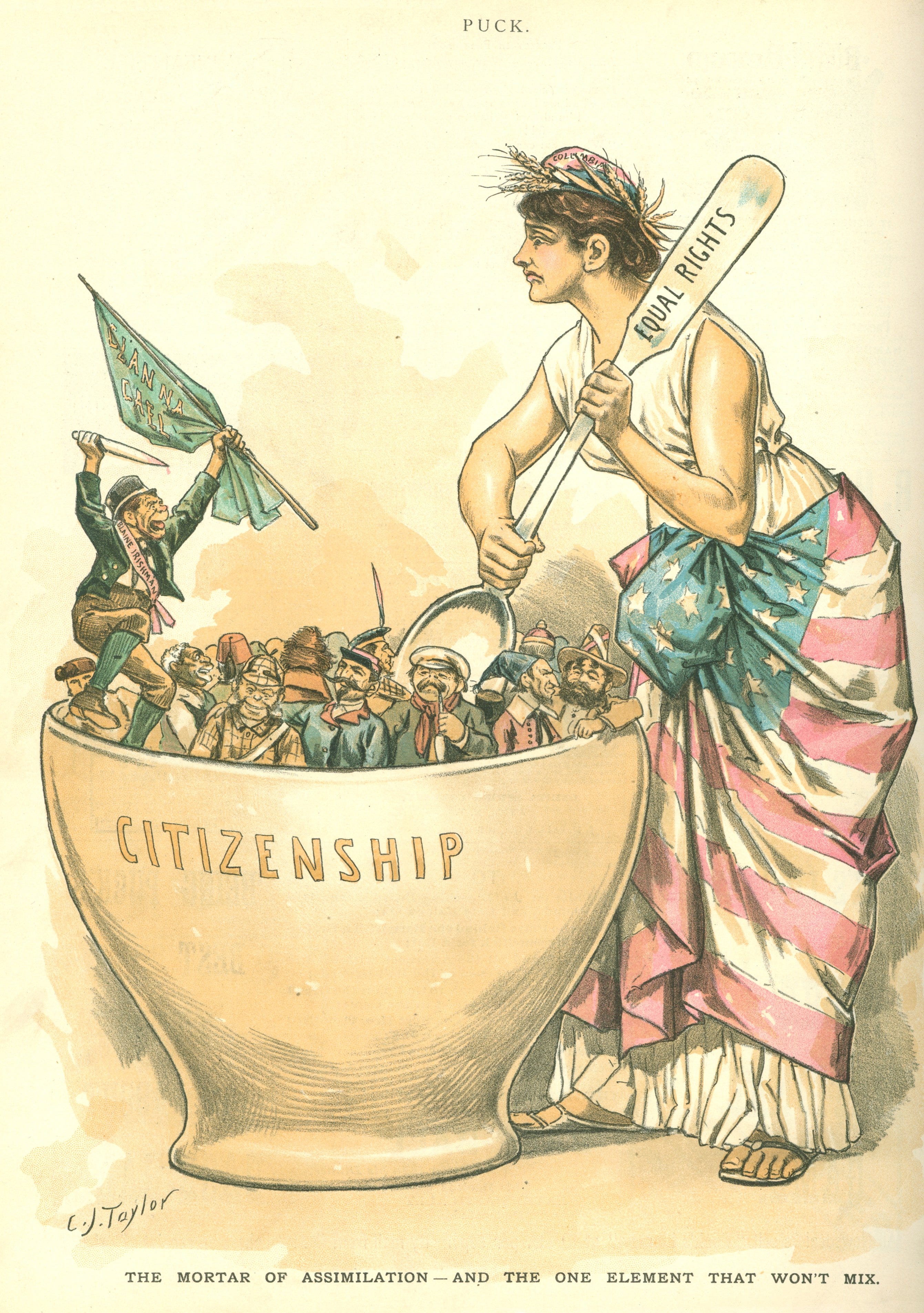
Know-Nothing anti-immigration propaganda
More than one million German immigrants arrived in the United States between 1840 and 1860, settling heavily in cities such as Cincinnati, St. Louis, and Milwaukee. Whether Catholic, Protestant, or Jewish, they attracted nativist criticism for maintaining beer halls, publishing German language newspapers, and observing the Sabbath less rigidly than native born Protestants. Even Protestant Germans were often viewed with suspicion, though generally with less hostility than their Catholic counterparts.
“Although the failure of the revolution did induce some well-known German radicals to emigrate, the preponderance of Germans emigrated for economic reasons.”
— Tyler Anbinder, Nativism and Slavery: The Northern Know Nothings and The Politics of The 1850s
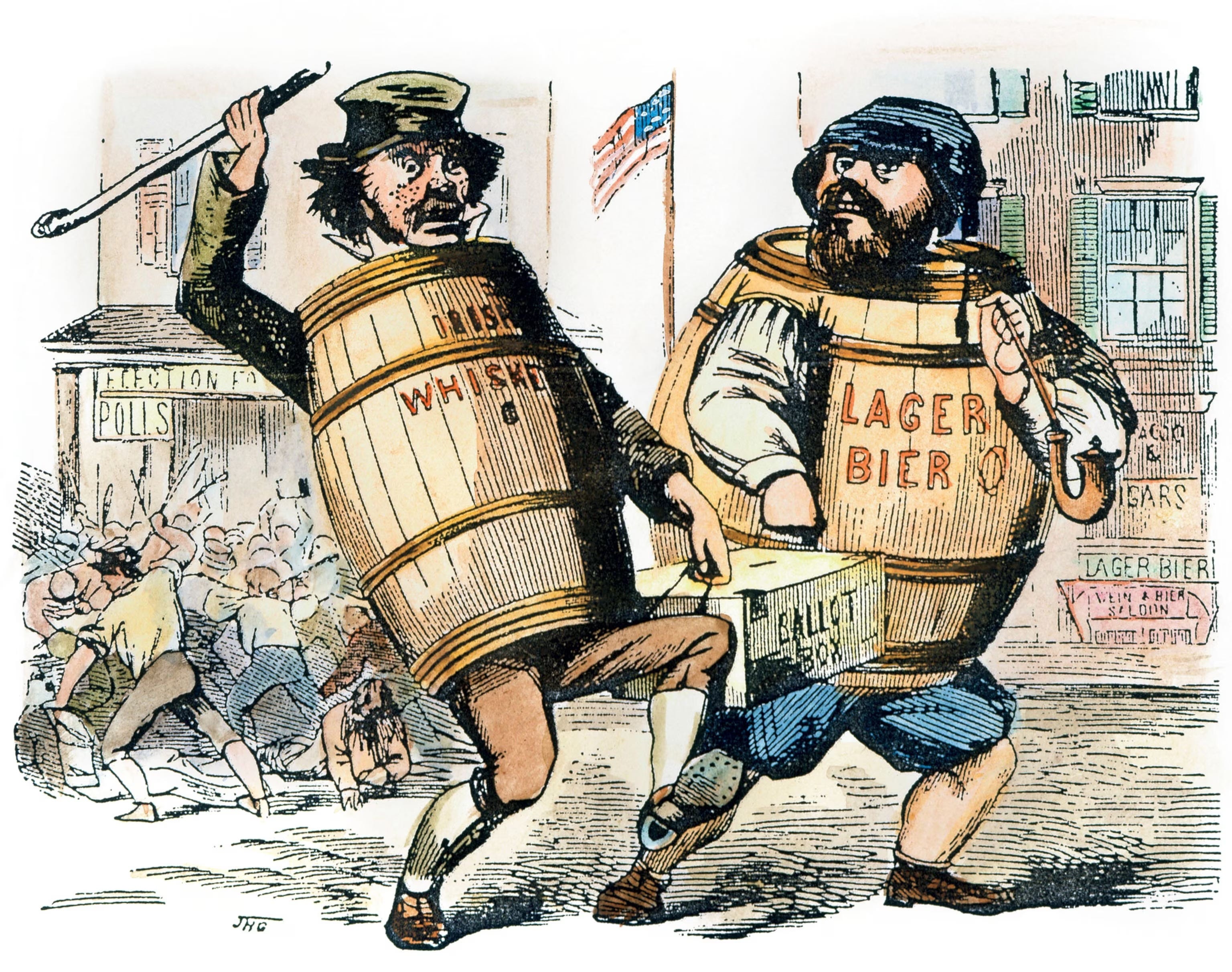
Know-Nothing anti-Irish and anti-German propaganda
The Know Nothings appealed strongly to artisans, small farmers, and local business owners, promoting an economic nationalism that favored protective tariffs and internal improvements. Party rhetoric supported higher duties on imported manufactured goods, often citing proposals for tariffs of roughly 30%, and endorsed infrastructure projects such as railroads to strengthen domestic commerce. Movement leaders blamed immigrant labor for depressing wages, arguing that foreign workers’ willingness to accept lower pay undercut native born laborers. A 1854 article in The American Republican claimed that immigrant labor harmed American workers by weakening wage standards. This message resonated in regions such as Alabama, where small farmers and artisans feared competition from immigrant labor connected to Mobile’s port economy.
Politically, the Know Nothings benefited from the collapse of the Whig party and growing voter disillusionment with Democrats, filling what historian Christopher Phillips describes as a widening political vacuum. At their peak between 1854 and 1856, the movement captured governorships in Massachusetts, Pennsylvania, and California, dominated several northern state legislatures, and sent more than one hundred members to Congress. In the 1854 elections alone, Know Nothing candidates won 52 seats in the House of Representatives. In Massachusetts, they enacted legislation restricting immigrant political influence and requiring Protestant Bible readings in public schools. In Alabama, the movement gained momentum in 1855, winning local offices in Mobile, but quickly declined as internal divisions over slavery fractured the party.
Nationally, the American party nominated Millard Fillmore for president in 1856, with Andrew Jackson Donelson as his running mate. Fillmore received 873,053 popular votes, approximately 21.5% of the total, and carried Maryland’s eight electoral votes, but ultimately lost the election to James Buchanan.
Abraham Lincoln criticized their exclusionary policies:
“I am not a Know-Nothing. That is certain. How could I be? How can any one who abhors the oppression of negroes, be in favor of degrading classes of white people? Our progress in degeneracy appears to me to be pretty rapid. As a nation, we begin by declaring that ‘all men are created equal.’ We now practically read it ‘all men are created equal, except negroes.’ When the Know-Nothings get control, it will read ‘all men are created equal, except negroes, and foreigners, and catholics.’ When it comes to this I should prefer emigrating to some country where they make no pretense of loving liberty—to Russia, for instance, where despotism can be taken pure, and without the base alloy of hypocracy [sic].”
— Abraham Lincoln, Letter to Joshua F. Speed, August 24, 1855
By the late 1850s, the movement’s fragile unity unraveled as the escalating national debate over slavery exposed irreconcilable sectional divisions. Northern members, including Nathaniel P. Banks, increasingly gravitated toward the anti-slavery Republican party, while southern Know Nothings, including those in Alabama, placed regional and pro slavery concerns above nativist unity. By 1860, the Know Nothing movement had effectively collapsed as a national political force.
On Nativism
The Legacy of Know Nothings
Although the Know Nothing movement was short lived, its ideas exerted a lasting influence on later waves of American nativism. Its hostility toward Catholic immigrants and those viewed as culturally or ethnically alien helped normalize the idea that immigration should be restricted based on perceived assimilability rather than solely on economic need. While the movement did not directly cause the Chinese Exclusion Act, its rhetoric contributed to a broader 19th century tradition of exclusionary thinking that made race based immigration policy politically acceptable. The 1882 law, which barred Chinese laborers from entering the United States, reflected this expanding nativist sentiment, even as it targeted a different population. Similar themes reemerged in the early twentieth century. The second incarnation of the Ku Klux Klan drew heavily on older nativist arguments, portraying Catholics, Jews, and immigrants from southern and eastern Europe, including Italians and Poles, as fundamentally unassimilable and disloyal. While distinct from the Know Nothings in organization and scale, the Klan echoed their insistence that American identity was rooted in Protestantism and northern European heritage.
The Know Nothings’ suspicion of Irish and German Catholics also anticipated the racialized nativism articulated by later writers such as Madison Grant and Lothrop Stoddard. Their arguments about racial hierarchy, cultural superiority, and national decline influenced elite and popular opinion in the early twentieth century and helped shape the intellectual climate surrounding the Immigration Act of 1924, which imposed restrictive national origin quotas favoring immigrants from northwestern Europe while sharply limiting arrivals from southern and eastern Europe and virtually excluding Asians. Economically, the Know Nothings’ emphasis on protecting artisans, farmers, and small business owners through tariffs, internal improvements, and resistance to immigrant labor foreshadowed later currents of economic nationalism. Elements of this outlook reappeared in aspects of late 19th century populism, certain Progressive Era reforms, and later “America First” movements that emphasized domestic industry and cultural cohesion. These themes surfaced in groups such as the Silver Legion of America, the America First Committee, and in modern nationalist political rhetoric of Donald Trump, though each reflected distinct historical contexts rather than direct continuity.
As historian Eric Foner has noted, movements like the Know Nothings expressed deep anxieties about national identity, cultural unity, and the pace of social change in a rapidly diversifying society. Few figures carried these anxieties more explicitly into the interwar period than Lothrop Stoddard, a self described progressive liberal whose admiration for Nazi racial ideology illustrated how 19th century nativist fears could evolve into 20th century white nationalism.
