
The Odin Prophecy
by Zoltanous
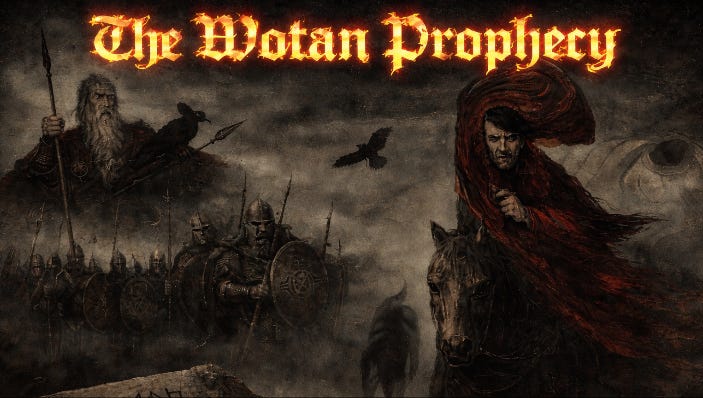
The prophecy of Odin does not exist as a single oracle, rune, or medieval sentence waiting to be fulfilled. It exists as a recurring historical configuration, a mythic mechanism that activates under specific social and psychological conditions. To misunderstand this is to treat prophecy as superstition rather than as cultural pattern recognition. Germanic myth never framed Odin as a god of peace or moral instruction. Odin is a god of seizure, of frenzy, of compelled movement. He appears when a people abandons equilibrium and seeks meaning through intensity.
The Wild Hunt is the clearest expression of this. Across German, Scandinavian, and Anglo-Saxon folklore, the Hunt is described as a furious procession that erupts during periods of war, famine, plague, or social collapse. The Hunt is not primarily visual, it is auditory: Wind, horns, hooves, shouting, screaming. The sound comes first,That ordering is not poetic flourish. Sound is the fastest method of synchronizing bodies at scale. A population that hears itself moving in unison has already entered seizure before it understands what it is moving toward. This is why the Hunt is not a salvation myth. It does not rescue, it mobilizes, it turns the sky into a marching street, it reframes chaos as destiny. People caught in the Hunt are not persuaded, they are taken. This is the original meaning of Wotan as Ergreifer, the seizer.
Odin is not a creator god. He does not rule the cosmos through law. He rebels against cosmic order to gain knowledge. He sacrifices himself to himself, hanging wounded on the world tree to steal the runes. Authority is earned through ordeal, knowledge is seized, not granted. Movement is preferable to stability, conflict is preferable to stasis. This is the archetype embedded in the prophecy. When prophecy is understood this way, it ceases to be mystical and becomes totalist. It describes what happens when a society’s symbolic immune system collapses.
By the 19th century, German intellectual life had already begun excavating this dormant structure. Romanticism, Wagnerian opera, Nietzschean philosophy, and Symbolist art all converge on a shared intuition: Christianity had hollowed out Europe’s older mythic energies without replacing their psychological function. Moral systems remained, but ecstatic systems were suppressed. The body was disciplined. The voice was regulated. Trance was confined to liturgy or outlawed as heresy.
This suppression did not eliminate the capacity for collective intoxication. It preserved it. This is why art matters. Art is where suppressed myth rehearses its return. No image is more important in this regard than Franz von Stuck’s The Wild Hunt (1889). The year alone is symbolically charged, not because dates are magical, but because symbolic cultures interpret coincidence as a signal, 1889 is the birth year of Adolf Hitler. Von Stuck’s Odin is not depicted as a folkloric relic. He is modern, stripped, airborne, dominating the frame. The riders behind him are blurred into motion, their individuality erased. The image is not about the past, this is a template. As some noted, von Stuck’s Wotan bears an uncanny resemblance to Hitler, almost as if the painting channeled a future archetype into form. Carl Jung later reflected on this synchronicity, suggesting that such artistic eruptions signal the stirring of collective unconscious forces, where myth anticipates history.

Franz von Stuck, The Wild Hunt (1889)
If mythology is the language of the soul, then The Wild Hunt teaches a society what possessed authority should look like. When that silhouette later appears in real life, it feels inevitable rather than constructed. Prophetic patterns do not activate in stable societies, they require fracture. Post-World War I Germany was a near-perfect activation environment. Military defeat, versailles humiliation, hyperinflation that annihilated trust in money, 6 million unemployed by 1932, regional identities without national coherence, Christianity present but psychologically inert, ritual without ecstasy, and morality without meaning.
This is where the “nation-soul” becomes precise rather than poetic. The nation-soul is the collective self-image that decides what reality is allowed to mean. When that self-image fractures, the population seeks reenchantment. Not solutions…. meaning, destiny, and a story that makes suffering feel chosen rather than random occurrence. Prophecy supplies that story when chaos is meaningless, societies fragment. When chaos is framed as the beginning of a Hunt, societies unify instantly. The Wild Hunt is heard before it is seen. This matters more in the 19th century than in the 10th.
Modern technology made mass auditory synchronization scalable. Loudspeakers, rhythmic chanting, call-and-response, silence used as punctuation. These are not political tricks, they are ritual translated to mass propaganda. Christianity mastered them long before modern states existed. Chant, liturgy, architecture, and resonance. The nervous system obeys rhythm before it obeys argument. When those technologies were removed from ethical containment and reinserted into mass politics, the result was not persuasion but possession. This is why the rallies matter, this is why the salutes matter, this is why repetition matters. A synchronized body does not ask whether it agrees, it just moves. If the prophecy establishes pattern and seizure as a mechanism, the theological engineering problem confronted by National Socialism becomes clear once mass mobilization transforms into a durable social reality. A society can be seized temporarily through spectacle and sound, but it cannot be held indefinitely without a legitimating metaphysics. This is where aspects of Positive Christianity enters, not as belief, but as tool.
Positive Christianity was never intended to resolve theological questions. It existed to solve a practical contradiction. Germany remained overwhelmingly Christian in identity, habit, and ritual memory. Churches still structured weeks, calendars, marriages, funerals, and moral vocabulary. Any movement that openly rejected Christianity would have fractured its own base. At the same time, orthodox Christianity imposed ethical, historical, and symbolic limits incompatible with a myth of destiny, struggle, and purification. The solution was not abandonment but revision.
“Party as such advocates the standpoint of a positive Christianity without binding itself confessionally to any one denomination.”
— National Socialist German Workers’ Party, 25 Point Program
This sentence is technical, it preserves Christian legitimacy while dissolving doctrinal constraint. Christianity is affirmed as mood, heritage, and authority, but not as theology. What remains is a ritual shell capable of housing a different mythic engine. This maneuver only works because Christianity already possessed the most effective mass ritual technologies in European history. Chant, call and response, architectural acoustics, repetition, calendrical rhythm, and collective posture had been refined for centuries. Positive Christianity did not invent new tools. It inherited them while severing their ethical anchor.
This is why the term positive matters. It does not mean optimistic, it means selective activation. Elements that produced obedience, sacrifice, and unity were retained. Elements that constrained power, emphasized humility, or universalized moral obligation were discarded. The central obstacle to this revision was Jesus himself. Within orthodox Christianity, Jesus is inseparable from Jewish history. He is a 2nd Temple Jew, his message is rooted in Hebrew scripture, his ethical universalism is explicit, and his confrontation with power ends in refusal of worldly kingship. This Jesus cannot function as a myth of national destiny or heroic struggle, it is an internationalist messianic nature. He must be transformed, this is where Gnostic inversion becomes indispensable.
Classical Christian Gnosticism is structurally anti-Judaic in a theological sense. It reframes the God of the Old Testament as a lesser or false creator, the Demiurge, associated with law, materiality, judgment, and constraint. Salvation is not obedience but escape through secret knowledge. Jewish adherence to Mosaic law is therefore cast not as covenantal fidelity but as metaphysical error. This predates modern racial anti-Semitism, but it provides a ready-made logic of displacement. When this logic is modernized and racialized, the result is explosive. Judaism becomes associated with legalism, stasis, and decay. The “true” spiritual principle is relocated to ancestry, blood, and heroic revolt. Salvation becomes awakening to destiny rather than reconciliation with God. This is not speculation, but documented intellectual history. Within National Socialist aligned thought, Jesus is progressively detached from Judaism and redefined as an Aryan spiritual warrior. He becomes a solitary rebel against priesthood, law, and moral constraint. His suffering is recorded not as redemptive love but as heroic martyrdom. Grace is replaced by struggle, mercy by purification.
The early ideological articulation of this move appears in the work of Rudolf Jung. In Der nationale Sozialismus: seine Grundlagen, sein Werden und seine Ziele, He argued that Christianity must be reclaimed from what he argued as distortion and made compatible with German racial temperament. Rudolf Jung did not construct a formal theology, he did something more operational. He provided justification for treating Christianity as organic, racial, and mythic rather than universal and historical. Jesus is reframed not as a Jew but as an Aryan opponent of Judaism. Rudolf Jung’s influence extended to blending Germanic pagan elements with this revised Christianity, viewing the All-Father not as a separate deity but as aligned with Christ in a solar, heroic wholeness.
Once Jesus is recorded in this way, the equivalence with Odin becomes structurally inevitable. Odin is not a creator god, he does not rule through law, he seeks forbidden knowledge, sacrifices himself to himself, and gains power through ordeal. He opposes stasis and incites movement, authority is seized, not inherited, knowledge is stolen, not bestowed. These traits align precisely with the Aryanized Jesus constructed through Gnostic views.
This is the crucial point I’m arguing here. Odin and Jesus are not fused because of superficial similarity. They are fused because they are made to occupy the same archetypal function: the initiatory rebel who awakens a people through suffering and conflict rather than redeems them through grace. This fusion explains why Nazism did not need to declare itself pagan. It needed Christianity as a carrier wave. Positive Christianity allowed churches, crosses, hymns, and moral language to remain intact while the internal engine changed. Pagan myth supplied frenzy, destiny, and sacrifice. Gnostic understanding supplied cosmology and Christianity supplied legitimacy.
This structural transformation is exactly what Carl Jung diagnosed in his 1936 essay Wotan. Jung did not describe a return to folklore. He described a replacement of salvific structures.
“Wotan is a restless wanderer who creates unrest and stirs up strife, now here, now there, and works magic…
He is the god of storm and frenzy, the unleasher of passions and the lust of battle; moreover he is a superlative magician and artist in illusion who is versed in all secrets of an occult nature.
“The Mediterranean father-archetype of the just, order-loving, benevolent ruler [the Christian God] had been shattered over the whole of northern Europe, as the present fate of the Christian Churches bears witness. Fascism in Italy and the civil war in Spain show that in the south as well the cataclysm has been far greater than one expected. Even the Catholic Church can no longer afford trials of strength. […]
The ‘German Christians’ are a contradiction in terms and would do better to join Hauer’s ‘German Faith Movement’… There are people in the German Faith Movement who are intelligent enough not only to believe, but to know, that the god of the Germans is Wotan and not the Christian God.”
— Carl Jung, Wotan
This statement does not mean Germans stopped attending church, it means the psychic organizing principle had changed. Ethical restraint gave way to possession and moral universality gave way to destiny. Christianity remained as form, but Wotan returned as function. Jung argued that the collective frenzy in Nazi Germany stemmed from a resurgence of this ancient “All-Father” archetype, with Hitler serving as its vessel. Germany had not chosen Hitler; Wotan had chosen Germany through him. Jung described Hitler as a “shamanic medium,” a hollow man whose emptiness allowed him to channel the German oversoul, embodying an archetypal god force that seized the populace. He contrasted the “Aryan” psyche, mythological, prone to projection and pagan identification, with the “Semitic” psyche, rooted in history, law, and tradition. This psychic vacuum made Germany vulnerable to Wotan’s possession, manifesting in Hitler’s hypnotic speeches and the regime’s rituals. Jung warned that archetypes like Wotan, suppressed under Christianity and demonized as the Devil, could erupt destructively when not integrated consciously.
At this point, the theological and mythic groundwork is complete. A population prepared through ritual, sound, and symbolism. A religion hollowed out and repurposed. A Gnostic cosmology that displaces Jewish history and universal ethics. A fused Odin-Jesus archetype that legitimizes suffering and struggle. What remains is the human convergence point, this convergence point is Hitler.
The transition from theology to embodiment reveals Hitler not as a god but as a messianic vessel, a living symbol through which the prophetic pattern completes itself. Hitler functions as the Ergreifer (the one who seizes) incarnate, the seizer who channels the archetype without fully originating it. This role is amplified by ritual, sound, and repetition, transforming personal charisma into mythic inevitability. The Nuremberg rallies exemplify this: torchlight processions symbolize purification and illumination, evoking the Wild Hunt’s auditory and visual frenzy; synchronized salutes merge individual wills; speeches build trance through rhythmic crescendos. These elements do not persuade, they possess, making Hitler the focal point of collective seizure. His admiration for von Stuck’s The Wild Hunt, with its Odin figure eerily resembling him, reinforces this: Hitler intentionally modeled his appearance after it, fulfilling the prophecy as a Germanic redeemer born in the painting’s year. Post-war esotericists like Miguel Serrano and Savitri Devi elevated this further, viewing Hitler as an avatar, Serrano’s “ultimate avatar” blending Gnostic, Hindu, and Nordic myths against the Demiurge; Devi’s Vishnu incarnation destroying to preserve in Kali Yuga. This embodiment completes the Wild Hunt: not episodic folklore, but enacted destiny.
Jung, who met Serrano, warned him not to confuse archetype with incarnation. To Jung, Hitler embodied Wotan, seizing the German psyche, but Serrano insisted Hitler was literally the Avatar of Wotan-Vishnu, a divine being sent to end the Kali Yuga. Serrano, initiated into an esoteric order practicing ritual magic, tantra, and kundalini yoga, claimed allegiance to a Himalayan Brahmanic elite akin to Helena Blavatsky’s. This order viewed Hitler as an initiate of boundless willpower, a Bodhisattva incarnated to overcome the dark age, communicating astrally with him. Serrano’s Esoteric Hitlerism portrayed Hitler as the Last Avatar, restoring Hyperborean gnosis against Jewish “lunar” influences. He cast Hitler as the Gnostic Christ, opposing the Demiurge Jehovah, elevating anti-Semitism to a cosmological doctrine. Hitler, in this view, did not die but withdrew to Shambhala, awaiting return. Devi similarly saw him as Vishnu’s Ninth Avatar, a Man Against Time resisting entropy.
“Moreover an Avatar does not commit suicide. He is the Lord of Voluntary Death: Matyamjaya. He detaches himself, goes away, leaving the body or with the body in a disk of fire, of gold, of orichalcum. Hitler was not free to decide about this as a man, being within a Hyperborean Archetype, or the Archetype being within him. Archetype of the Führer. And a God does not commit suicide. Wotan does not commit suicide. Kristos lives. He only vanishes, leaving his body or disappearing with his body, like the sun in its setting. In the Twilight of the Gods. With music of Wagner, as Admiral Dónitz arranged when he announced his departure.”
— Miguel Serrano, Adolf Hitler: The Ultimate Avatar
Julius Evola offered a counterpoint, viewing Hitler as a destructive instrument of decline, channeling the Volk’s psychic energy without control, leading to mass-demonism rather than true order, powerful but too bound to matter to achieve transcendence. Debates on Hitler’s own views on Wotan persist; Table Talk quotes him rejecting a return to Wotan worship, but some critics argue the text is forged or misunderstood, given limited knowledge of paganism at the time. To fully grasp the Wotan prophecy’s activation, one must trace the deeper occult strains that predated and influenced these developments, particularly the Ariosophic and Theosophical currents that fused Gnostic views into völkisch thought. Helena Blavatsky’s Theosophy, with its emphasis on ancient Aryan root races and hidden masters in Tibet, provided a pseudohistorical framework for reclaiming “lost” spiritual knowledge. Blavatsky’s Secret Doctrine posited a Hyperborean origin for Aryans, free from Semitic influences, and framed the swastika as a universal solar symbol of divine energy, ideas that resonated with Gnostic dualism by contrasting “pure” spiritual races against material corruption. This Theosophical influence seeped into German occult circles, where it was racialized further by figures like Guido von List and Jörg Lanz von Liebenfels.
Von List, a key architect of rune mysticism, reinterpreted the Elder Futhark (runes) as a sacred Aryan alphabet encoding cosmic laws, accessible only to initiates. In Das Geheimnis der Runen, he blended Gnostic esotericism with Germanic myth, viewing runes as tools for awakening blood-memory and overthrowing “alien” Christian dogma. This Ariosophic approach presented runes as sacred racial symbols originating with and belonging to the Aryan race, with everyday motifs like the heart symbol tied to ancient Ario-Germanic hail signs and concepts like “Acht” (to heed or honor).
“That intuitively discovered self-revelation and knowledge of God grew constantly in proportion to the spiritual development of the highest-standing White man, the Aryan.”
— Guido von List, Buddhism, Christianity, and Armanism
Lanz von Liebenfels, founder of The Ordo Novi Templi (Order of The New Templars), took this further by inventing Ariosophy, a system that explicitly Gnosticized Christianity. Lanz portrayed Jesus as an Aryan god-man battling “beast-men” (racial inferiors aka non-whites), drawing on Manichaean dualism to divide the world into light (Aryan) and dark (Semitic) forces. His Ostara magazine, which Hitler reportedly read in Vienna, propagated these ideas, framing history as a racial holy war against the Demiurge’s agents. Lanz viewed the Aryan as the sole embodiment of humanity and heroism, with non-Aryans dismissed as subhuman “Tschandalas,” a term borrowed from Nietzsche but twisted into a cosmological hierarchy. He envisioned an eschatological war where the Reich might fail, leading to apocalypse, purge, and Aryan victory in a “Fourth Reich,” with the heroic race, heroes, saints, and mystics, as the highest blossoming of true humanity.
“The Aryan race is the moral and religious race. Later in the Apocalypse, the white rider is indeed identified with the Logos, i.e., with Frauja Christ, the ancestor of the heroic race.”
“The heroic race has since primeval times been the race of heroes, saints, and mystics. The hero and the saint are the highest blossoming of humanity.”
— Jörg Lanz von Liebenfels, Bibliomystikon
These strains converged with Houston Stewart Chamberlain’s racial theology in The Foundations of The 19th Century, which influenced Hitler profoundly. Chamberlain, Wagner’s son-in-law, argued that Aryans were the true inheritors of Christ’s message, corrupted by Jewish “materialism.” He fused Teutonic myth with Gnostic anti-Judaism, portraying Wotan as a proto-Christ figure embodying creative chaos against Semitic order, echoing Nietzsche’s Dionysian frenzy, though Nietzsche himself rejected racial mysticism.
Nietzsche’s own contributions, often distorted by Nazi’s like his sister Elisabeth Förster-Nietzsche, added philosophical fuel. His proclamation of “God is dead” in Thus Spoke Zarathustra diagnosed Christianity’s exhaustion, paving the way for a “will to power” that Nazis reinterpreted as racial destiny. Though Nietzsche despised anti-Semitism and nationalism, his emphasis on heroic overcoming and eternal recurrence aligned superficially with Wotan’s ordeal-driven archetype, amplifying the call for mythic revival.
Richard Wagner’s operas, particularly the Ring cycle, served as a mythic blueprint. Wotan, the flawed god-king who sacrifices for forbidden knowledge, mirrors the self-hanging Odin, embodying tragic destiny and world-rending conflict. Wagner’s recurring musical themes, functioned like auditory runes, synchronizing emotions at scale. Hitler revered Wagner, attending Bayreuth festivals and drawing on the composer’s antisemitic essays like Judaism In Music, which framed Jews as cultural parasites. Wagner’s Gesamtkunstwerk (total artwork) prefigured Nazi spectacles, blending myth, music, and ritual to reenchant the Volk.
These occult influences stained the ideological fabric, providing an intellectual justification for Gnostic views. Alfred Rosenberg, the regime’s chief ideologue, synthesized them in The Myth of The Twentieth Century, declaring Christianity a “Jewish poison” to be purged through a new Germanic faith. Rosenberg envisioned a “blood religion” where Wotan and an Aryan Christ merged in a Gnostic hierarchy, with the Demiurge as the Judaic god of bondage. His work, though criticized by Hitler for its abstruseness, institutionalized these strains, influencing education and policy. Ariosophy’s eschatological visions, such as von List’s apocalyptic purge leading to a sixth root race of spiritually higher Aryans or Lanz’s failure of the Reich followed by purge and a Fourth Reich, echoed in modern cultic parallels like Charles Manson’s “Helter Skelter,” themes of racial cataclysm and purification. These ideas reinforced unfalsifiable concepts like “blood memory,” critiqued even by contemporaries as bizarre cultic claims, yet they persisted in framing history as a war between races resolved through reincarnation and hierarchical karma, where lower races serve to earn ascension and humanitarianism is dismissed as a deception of inferior beings.
If the incubation of myth within lodges and völkisch environments laid the groundwork, the next phase turns backward into the incubation layer that made such completion possible without appearing artificial. No myth activates at scale unless it has already been rehearsed in smaller, denser environments where symbolism, language, and identity can be refined without scrutiny. In early twentieth century Germany, this incubation did not occur primarily in churches, universities, or parliaments. It occurred in lodges, study circles, paramystical societies, and völkisch clubs that blurred the line between scholarship, nationalism, and ritual.
The most famous of these environments is the Thule Society, founded in Munich in 1918. Thule was not a mass organization and did not need to be. Its function was catalytic. It operated as a place in which older Germanic myth, racial theory, anti-Semitic theology, and occult practice were fused into a coherent worldview that could later be simplified for popular consumption. Thule’s membership included aristocrats, academics, military officers, and political agitators, precisely the strata capable of transmitting ideas downward into institutions.
The Society took its name from Thule, a mythical northern land described in classical sources as the farthest edge of the world. In völkisch imagination, Thule became a symbol of primordial origin, a lost Aryan homeland beyond history. This symbolism matters. By positioning origin outside recorded time, myth is insulated from empirical challenge. It becomes unfalsifiable and therefore usable as destiny. Thule Society meetings combined political discussion with symbolic practice. Runes were traced not as decorative but as concentration devices, believed to channel ancestral energy and sharpen will. Meditation on Nordic symbols functioned as identity conditioning. Myth was not read, it was inhabited. Participants did not merely learn what to believe, they learned how to feel when believing.
Several figures associated with early National Socialism passed through this environment. While later narratives often exaggerate direct command chains, the more important transmission was cultural rather than hierarchical. Thule normalized the idea that politics could and should operate mythically. Rational discourse was insufficient, a people required reenchantment. The Thule Society also sponsored the German Workers’ party, the small Munich group that would later become the NSDAP. This sponsorship was not about electoral success. It was about providing a vehicle through which incubated myth could enter public life. The party’s early meetings retained lodge-like characteristics. Small rooms, intense rhetoric, ritualized language, with identity formation through opposition rather than policy.
This lodge ecology extended beyond Thule. Völkisch organizations proliferated across Germany in the late nineteenth and early twentieth centuries, blending folklore preservation with racial theory and spiritual revival. These groups framed themselves as cultural, not political. That distinction allowed them to operate without triggering immediate repression. By the time overt political mobilization occurred, the symbolic groundwork was already laid.
Rune mysticism deserves particular attention here. Runes functioned as more than alphabetic curiosities. They were treated as pre-linguistic carriers of meaning, symbols believed to encode cosmic forces. This belief is not unique to Germanic culture, but its revival in modern Germany took on a specific function. Runes bypass semantic debate, they operate visually and kinesthetically. Drawing a rune is an action, it produces a feeling of participation rather than agreement. Ariosophists like von List extended this to symbolic interpretations of everyday symbols like the swastika, linking them to ancient Aryan hail signs and racial consciousness.
“And again and again, suddenly out of this fog of the unconscious, like a true sign, the swastika or hooked cross shines forth. Like an inner certainty of salvation, it irresistibly draws spirits and hearts to itself. Again and again it is: “In hoc signo vinces.” (”In this sign you shall conquer.”)”
— Herman Wirth, Ahnenerbe Germanien Issue 6
This is why rune imagery proliferated in SS insignia and ceremony. The symbols did not need to be understood intellectually. They needed to be felt. Identity formed around sensation, not argument. Parallel to rune mysticism, geopolitical mysticism developed through figures such as Karl Haushofer. Haushofer’s concept of geopolitics framed territory not merely as strategic space but as organic destiny. Nations were treated as living organisms that required expansion or suffocation followed. While Haushofer’s ideas were not purely occult, they resonated deeply with mythic conceptions of land as ancestral body.
This synthesis of land, blood, and destiny reinforced the Gnostic view described earlier. Material reality was no longer neutral, territory itself became sacred. Borders became wounds, expansion became healing, and opposition became an obstruction of destiny. The incubation phase also normalized anti-Semitism not simply as prejudice but as cosmological explanation. Jews were positioned as agents of disintegration, legalism, and materialism within this worldview. This framing did not require explicit violence at first, this functioned as a symbolic diagnosis. Social anxiety, economic collapse, and cultural fragmentation were attributed to an externalized metaphysical cause. The Gnostic structure made this attribution feel profound rather than conspiratorial.
Crucially, these ideas circulated in closed environments where contradiction could be excluded. Lodges, study circles, and societies self-selected for ideological alignment. Reinforcement occurred through repetition, shared ritual, and mutual affirmation. By the time these ideas reached mass politics, they had already been stripped of nuance and hardened into slogans. This incubation explains why later mass rituals felt ancient rather than invented. Participants recognized the forms even if they had never encountered them explicitly. The symbols resonated because they had already permeated cultural memory through art, literature, clubs, and education. By the early 1920s, the necessary components were in place. A mythic cosmology that displaced Judaism through Gnosticism. A reinterpreted Christianity capable of housing pagan mechanics. An archetype prepared through art and folklore. Ritual techniques refined in lodges. A political vehicle ready to receive them. The prophecy did not activate at once. It waited.
When myth transitioned from rehearsal to administration, it marked a decisive shift from awakening belief to enforcing inevitability. Once power was seized, the focus moved beyond stirring conviction to embedding myth into the structures of everyday governance, including bureaucracy, research, architecture, and timekeeping. This process rendered destiny not as a bold assertion but as an objective reality, seamlessly integrated into the fabric of the state.
Central to this transformation was the Ahnenerbe, founded in 1935 under SS auspices and Heinrich Himmler’s oversight. Officially presented as an institute for studying ancestral heritage, it operated as a myth-validation apparatus, retroactively authenticating the Nazi regime’s destiny. Rather than pursuing objective academic truth, it sought symbols, artifacts, texts, and practices that could be reinterpreted to portray the current political order as the fulfillment of an ancient Aryan lineage. This approach not only justified brutality but also advanced a metaphysical claim: morality became intra-organic, confined to the initiated elite, while outsiders represented deception and decay, a logical extension Gnosis where true order resided solely within the elect.
The Ahnenerbe’s expeditions exemplified this operational logic, dispatching teams to Tibet, Iceland, Scandinavia, the Alps, and the Near East under the guise of scholarly research. However, interpretations were predetermined; evidence was harvested to align with Aryan origin narratives, with contradictions ignored or reframed. This method resembled religious archaeology, where sacred history was confirmed rather than discovered, treating the past as a reservoir of legitimacy. Tibet held particular significance in the völkisch imagination, envisioned as a mythic counterpart to Thule, a pristine repository of primordial wisdom untouched by Western decadence, transcending Christianity and Judaism. These pursuits institutionalized Gnosticism: secret knowledge recovered by initiates validated the SS as an elite order that alone deciphered history’s true meaning, emphasizing separation from the masses over inclusion.
Complementing the Ahnenerbe’s temporal myth-making was its spatial counterpart at Wewelsburg Castle, redesigned not for administrative efficiency but as a ritual axis. Architecture served as a psychological tool, with circular chambers eliminating directional hierarchies, stone absorbing sound, and light meticulously controlled; the North Tower symbolized a center of meaning rather than governance. Solstice ceremonies there were acts of temporal realignment, shifting from Christian historical time to pre-Christian mythic cycles, thereby reorganizing causality itself through the calendar.
Orders transmitted identity through initiation, repetition, and ordeal, rendering belief embodied rather than optional. Bureaucratizing myth addressed the vulnerability of charismatic movements, which falter with a leader’s decline; instead, symbolic authority was dispersed across research institutes, ritual calendars, architecture, uniforms, and ranks, making destiny appear impersonal and enduring beyond individuals. This reinforced Adolf Hitler’s role, framing him as destiny’s instrument rather than its creator, insulating him from accountability and elevating opposition to an affront against history. Hitler articulated destiny, while the SS enacted it, a dynamic akin to religious systems where prophets reveal and priesthoods institutionalize.
Himmler’s personal occult fascinations infused the system with esoteric elements, such as the Black Sun mosaic at Wewelsburg, emblematic of alchemical transformation and hidden solar power, representing Gnostic inner enlightenment against material illusion. Ahnenerbe researcher Otto Rahn’s Grail quests in the Pyrenees interpreted the Holy Grail as a Cathar artifact symbolizing pure Aryan bloodlines uncorrupted by Catholicism, positioning the SS as modern Templars safeguarding secret knowledge. Though pseudoscientific, these endeavors legitimized the regime’s Gnostic worldview.
By this point, the prophecy of Odin had evolved from a fleeting pattern into a systematized reality, with the Wild Hunt shifting from episodic eruptions to scheduled rituals woven into daily life through ceremonies, youth organizations, uniforms, and architecture. The boundary between myth and reality dissolved, yielding perceptual rather than merely ideological effects. In a mythic state, cognition, conscience, and social reality transform under continuous ritual immersion, where belief yields to orientation and dissent crumbles under inevitability’s weight.
The hallmark psychological feature of such a state is moral flattening, where ethical language abounds but moral choice vanishes; actions are evaluated not intrinsically but by their alignment with destiny, supplanting conscience with loyalty. Contemporaries consistently described not rampant fanaticism but normalization, individuals felt “carried” by the pervasive ritual field. Youth organizations like the Hitler Youth prioritized somatic identity formation through rhythm, song, marching, uniforms, and hardship, instilling belonging before ideology. Adults underwent parallel processes via workplace rituals, party meetings, commemorations, and redefined holidays, mythologizing time itself until doubt became untenable and resistance seemed irrational.
“When Winterwode’s wild hunt roars across the fields, Frau Holle’s wise maid tends what Wode’s storm has too wildly ruffled.
A white linen covers the land, protectively enveloping the young seedlings, until a new spring arrives, yielding an autumnal harvest.
Though Fenris the wolf devours the light in his dull greed, ancient ancestral belief speaks:
No wolf can ever conquer the sun!
For in the vast expanse of the universe, high above the dark winter night, the Tree of Life grows eternally, reaching to the stars’ bright splendor.”
— Karl-Heinz Bolay, Deutsche Weihnachten: Ein Wegweiser für Gemeinschaft und Familie
Sound played a pivotal role in sustaining this immersion, with loudspeakers turning public spaces into ritual environments where authority’s voice became omnipresent noise, charging even silence with meaning. This auditory saturation evoked religious parallels, bells, chants, calls to prayer, but submerged the individual in collective identity rather than elevating toward transcendence. Carl Jung termed this “possession” by archetypes, not as madness but as ego displacement within a constricted symbolic horizon, rendering alternatives invisible. This explains the post-war paradox: many participants in brutality professed benign intentions, viewing actions as necessary functions rather than deliberate choices, where violence corrected the “unreal” enemy, eroding empathy without demanding sadism.
Conclusions
Even if we dismiss the pagan shadows haunting the Nazi party, banishing the runes, the SS runes, Himmler’s castle-bound rituals, the Thule’s arcane whispers and cling solely to its proclaimed Christian facade, what emerges is no orthodox faith but a heresy reborn, a resurrection of the ancient Gnostic currents purged in the fires of early councils from Nicaea to Chalcedon. Gnosticism surges forth not as doctrine but as mechanism: a dualistic fracture splitting the cosmos into the Demiurge’s tyrannical material prison, equated with Yahweh’s “Jewish” chains, the Old Testament’s false creation, and the transcendent spark of true divinity, gnosis unlocked only for the elect through inner seizure, not sacramental grace. This is no mere echo; it is reassertion, where Nazism revives the suppressed sects, the Valentinians, the Marcionites, the Manichaeans, infusing Christianity with racial blood as the key to revelation, apocalyptic war as salvation’s ordeal, and contempt for the corrupt flesh of the world, mirrored in the regime’s eugenic purges and mythic narratives of Aryan light piercing Semitic darkness.
Counter this, if you will, with the regime’s public piety, “Gott mit uns” etched on belts, pacts with compliant churches, but such gestures are masks, tactical veils over a subversion that shreds the Trinity, universal redemption, and creation’s sanctity, replacing them with a Volk-prophet’s frenzy, where Jesus becomes the anti-Demiurge rebel, not the suffering servant. Hitler’s own words in Mein Kampf show this disdain for “effeminate pity,” exaltation of a militant creed aligned with nature’s ruthless law, ordeal over mercy, surviving in underground streams like the Cathars’ dualism or Bogomils’ rejection.
This mythic activation exceeds the calculated fictions of thinkers like Georges Sorel, whose syndicalist myths, the “general strike” as irrational spur, served as pragmatic tools for proletarian uprising, class-bound and rootless, mere vitalist sparks without cosmic depth. Sorel’s myth mobilizes; it does not possess. Nazism’s, in contrast, seizes utterly: an organic eruption from the Volkseele, a living archetype woven of racial essence, eternal Ragnarök cycles, destruction as rebirth’s prelude, demanding not action but existential immersion, total surrender to the prophetic storm, far more extreme in its anti-rational totality, its hypnotic demand for frenzy over strategy.
And in scope, it shatters traditional corporatist views of society, those harmonious hierarchies of estates, classes fused under state arbitration, as in Mussolini’s charters or medieval guilds, pragmatic pacts for social cohesion, mutual duties without divine mandate. Nazism infuses them with mystical organicism: society as sacral body, animated by blood’s purity, the Führer’s seizure as divine will, where economic roles dissolve into cosmic struggle, eugenics as redemption’s forge, expansion as destiny’s hunt, not organization, but ecstatic unity toward apocalyptic renewal. Thus, by awakening this Gnostic heresy in Christianity, Nazism unmasks the eternal pattern: ecstatic reenchantment’s lure in collapse, archetypes poised to erupt anew, seizing the collective soul when rational order dies.